
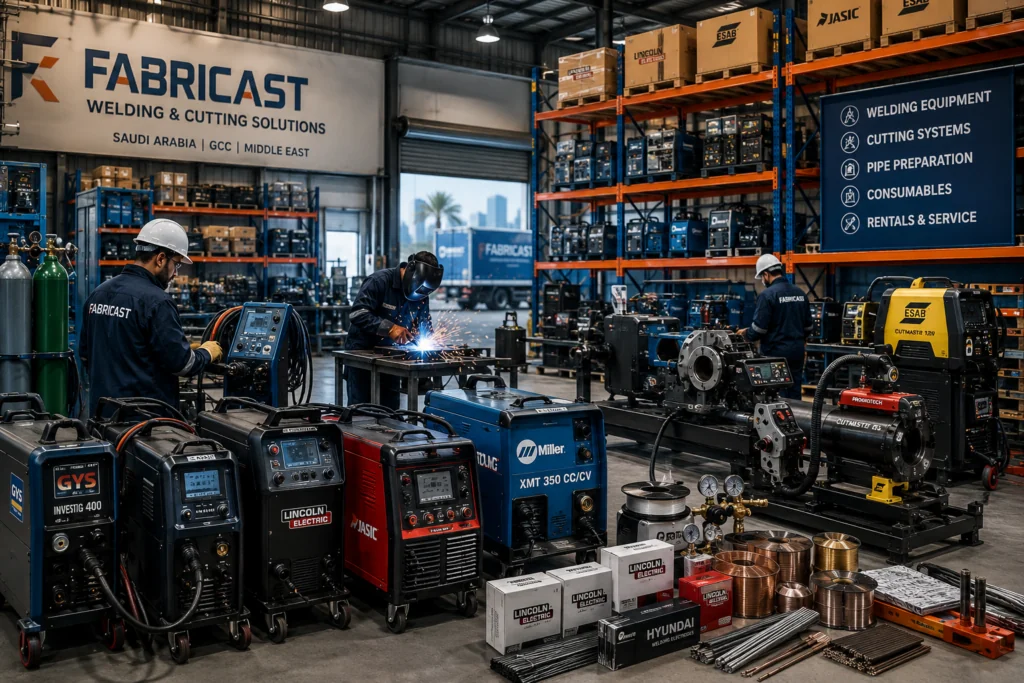
Industrial projects depend on more than skilled operators and timelines—they depend on access to dependable equipment, technical support, and a distribution partner that understands operational demands. Whether the requirement is fabrication, construction, energy infrastructure, manufacturing, shipbuilding, or maintenance, selecting the right welding and cutting equipment distributor directly affects productivity, quality, cost control, and project outcomes.
Across Saudi Arabia and the GCC, industrial operations increasingly require faster procurement, stronger equipment availability, and access to globally recognized welding technologies. Fabricast operates as a welding and cutting equipment distributor serving industrial sectors with equipment supply, rentals, consumables, and support solutions across multiple welding and cutting categories.
This guide explores how welding and cutting distributors create value, what equipment categories matter most, and how businesses can choose solutions that support long-term operational success.
Why a Welding and Cutting Equipment Distributor Matters
Industrial welding is no longer simply about owning a machine. Modern projects demand integrated support—equipment selection, delivery coordination, maintenance readiness, consumables availability, and technical guidance.
A professional distributor acts as a strategic supply partner rather than a seller.
Working with an experienced distributor helps organizations:
- Reduce procurement delays
- Improve equipment utilization
- Access global technologies
- Scale capacity for large projects
- Lower maintenance interruptions
- Improve welding quality consistency
Fabricast supports industrial customers through equipment distribution, rentals, and access to globally recognized product lines across GCC markets.
Understanding Modern Welding and Cutting Equipment Categories
Different industrial applications require specialized processes. Selecting equipment based on application requirements improves efficiency and reduces rework.
1. MIG Welding Equipment
Metal Inert Gas (MIG) welding remains one of the most widely used industrial welding methods.
Ideal applications include:
- Structural fabrication
- Manufacturing facilities
- Heavy construction
- Automotive components
- Industrial production lines
Benefits include:
- High production speed
- Consistent weld quality
- Lower operator fatigue
- Strong automation compatibility
For operations requiring production throughput, industrial MIG welding machines often become the preferred solution.
2. TIG Welding Systems
TIG welding provides exceptional precision and clean finishes.
Common applications:
- Stainless steel fabrication
- Aerospace components
- Pipeline fabrication
- Precision engineering
- Food-grade manufacturing
Advantages:
- Superior weld appearance
- Excellent control
- Reduced contamination
- Suitable for thin materials
Businesses requiring precision frequently invest in advanced TIG welding solutions to maintain consistent standards.
3. Arc and Multi-Process Welding Machines
Arc welding continues to play a major role in industrial operations.
Industries using arc systems:
- Construction
- Oil & gas
- Repair facilities
- Heavy engineering
- Infrastructure projects
Multi-process systems add flexibility by combining multiple welding functions into one platform.
These solutions support:
- Operational versatility
- Faster deployment
- Reduced equipment footprint
This makes multi-process welding equipment attractive for diverse project environments.
4. Plasma Cutting Systems
Cutting quality influences the efficiency of downstream fabrication.
Plasma cutting equipment is commonly used for:
- Sheet metal processing
- Industrial fabrication
- Pipe preparation
- Structural steel cutting
Benefits include:
- Fast material removal
- High precision
- Reduced waste
- Improved production flow
Modern operations increasingly prioritize precision cutting technologies to optimize fabrication output.
The Role of Equipment Distribution in Industrial Productivity
Distribution affects more than inventory availability.
Reliable distributors help companies maintain continuity through:
Equipment Availability
Project delays often result from supply gaps.
Distributors that maintain broad inventory reduce downtime and improve scheduling flexibility.
Technical Support
Industrial environments require proper machine matching.
Support teams assist with:
- Process selection
- Equipment sizing
- Operational recommendations
- Consumables compatibility
Service and Maintenance
Maintenance support extends equipment lifespan and minimizes failures.
This becomes especially important for:
- High-duty cycle applications
- Remote project sites
- Continuous manufacturing operations
Organizations increasingly depend on welding equipment maintenance services to protect productivity.
Fabricast highlights equipment support, delivery responsiveness, and maintenance assistance as part of its industrial service approach.
Industries That Depend on Professional Welding Equipment Distribution
Industrial equipment distribution supports a broad range of sectors.
Construction and Infrastructure
Construction environments require rugged equipment with high uptime.
Typical requirements:
- Portable welders
- Diesel welding systems
- Cutting solutions
- Consumables management
Oil and Gas
Oil and gas projects require:
- High reliability
- Compliance requirements
- Precision pipe preparation
- Continuous operation capability
Specialized cutting and welding systems improve consistency across demanding environments.
Manufacturing and Fabrication
Manufacturing facilities benefit from:
- Automated compatibility
- Production efficiency
- Repeatable quality
Investment in fabrication welding equipment suppliers often creates measurable operational improvements.
Pipeline and Heavy Industry
Large-scale industrial projects frequently require:
- Pipe beveling
- Pipe preparation
- Industrial welding systems
- Heavy-duty equipment platforms
Distributors with broad equipment portfolios support project continuity.
Key Features to Look for in a Welding and Cutting Equipment Distributor
Choosing a distributor should go beyond comparing product catalogs.
Evaluate the following:
Product Diversity
Distributors offering multiple technologies simplify procurement.
Look for access to:
- MIG systems
- TIG systems
- Arc machines
- Plasma cutters
- Pipe preparation
- equipment Consumables
Fabricast offers equipment categories across multiple international manufacturers and industrial applications.
Brand Portfolio Strength
Strong distributors partner with established manufacturers.
Available product categories through Fabricast include solutions from multiple global welding and cutting brands including Lincoln, GYS, JASIC, TAG, Hyundai, Shindaiwa, DMI, Uniarc, and others.
Rental Flexibility
Not every project requires ownership.
Rental solutions support:
- Shutdown projects
- Temporary expansion
- Specialized jobs
- Emergency replacement
Flexible access enables companies to control capital expenditure.
Delivery Capability
Fast deployment minimizes project interruptions.
Industrial customers benefit from:
- Regional stock access
- Coordinated logistics
- Reduced procurement lead times
Why Equipment Rentals Continue to Grow
Many industrial businesses now combine ownership with rental strategies.
Rental benefits include:
Lower Capital Commitment
Companies preserve cash flow while maintaining operational flexibility.
Access to Updated Technology
Projects can use current-generation equipment without replacement cycles.
Reduced Maintenance Burden
Service responsibility often shifts to the provider.
Fabricast positions rentals as a practical option for fabrication, construction, oil & gas, and infrastructure operations that require flexibility and availability.
Businesses seeking agility increasingly explore cost-effective welding equipment rentals alongside permanent asset strategies.
How Technology Is Changing Welding Distribution
Industrial distribution continues evolving.
Key trends include:
Digital Controls
Modern equipment enables:
- Better arc stability
- Performance tracking
- Parameter consistency
Energy Efficiency
Lower operating costs remain a major purchasing factor.
Integrated Industrial Solutions
Customers increasingly prefer one supplier capable of delivering:
- Machines
- Consumables
- Accessories
- Technical guidance
- After-sales support
This demand continues to strengthen complete welding and cutting solutions across industrial markets.
Building a Smarter Equipment Strategy
Successful operations combine the right equipment with the right supply relationships.
Questions to ask before selecting a distributor:
- Do they support multiple industries?
- Can they supply rentals and permanent equipment?
- Do they provide technical guidance?
- Is inventory availability reliable?
- Are recognized industrial brands available?
- Can they scale with project growth?
The answers influence project timelines, operating cost, and long-term performance.
Conclusion
Industrial performance starts with dependable equipment and dependable supply. A trusted welding and cutting equipment distributor provides more than machinery—it provides continuity, expertise, flexibility, and operational confidence.
Whether supporting fabrication workshops, construction developments, energy projects, or manufacturing operations, choosing the right partner improves productivity while reducing delays and maintenance challenges.
With access to global welding technologies, broad equipment categories, rentals, and industrial support capabilities, Fabricast serves businesses across Saudi Arabia and the GCC with solutions designed to meet modern project requirements.