
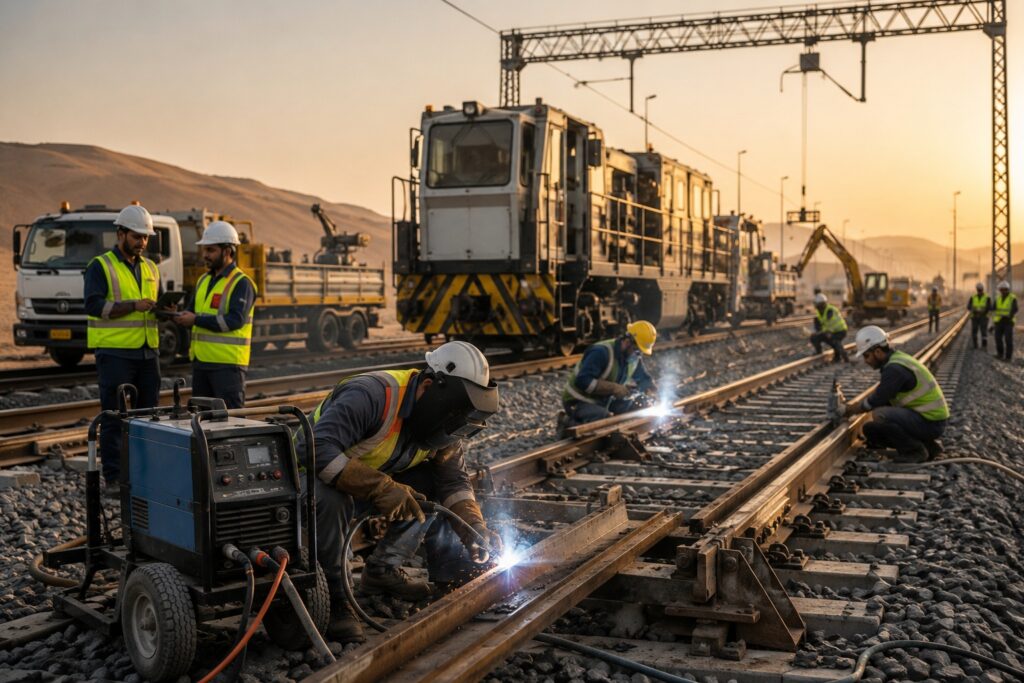
Welding Equipment Rentals Saudi Arabia give contractors, fabrication companies, maintenance teams, and industrial operators the flexibility to build welding capacity around each project’s actual requirements. Instead of maintaining every possible machine in a permanent fleet, businesses can bring in additional or specialized welding equipment for specific production phases, shutdowns, field assignments, or short-duration contracts. This project-based approach can improve equipment utilization while helping teams respond faster when workloads change.
In Saudi Arabia, welding requirements vary significantly between industries. A structural fabrication workshop may need high-output MIG systems, while a remote maintenance crew may require portable ARC machines. Stainless-steel fabrication may call for precise TIG equipment, while an outdoor project without dependable grid power may need an engine-driven welder.
For this reason, effective rental planning starts with the welding application—not simply the number of machines required.
Why Welding Rental Is Becoming Part of Equipment Planning
Equipment rental was once viewed primarily as a solution for emergencies or equipment breakdowns. Industrial operations increasingly use it more strategically.
Consider a contractor that normally operates eight welding stations but receives a project requiring fifteen welders during the fabrication peak. Purchasing seven additional machines could create excess equipment after the contract is completed.
Rental provides another option.
The contractor can retain its permanent fleet for normal operations and introduce additional machines only during the period when production is highest.
This makes industrial welding equipment rental useful for companies dealing with variable project pipelines, seasonal workloads, shutdown campaigns, and simultaneous contracts.
The objective is not simply to avoid ownership. It is to keep equipment capacity aligned with productive demand.
Build the Rental Fleet Around the Welding Process
One of the strongest advantages of renting is access to different welding technologies for different jobs.
A single project can involve several materials, joint configurations, and working environments. Using the same welding process everywhere may not provide the best productivity or weld characteristics.
A project-specific rental fleet could combine MIG, TIG, ARC, and multi-process systems.
MIG Welding Equipment
MIG systems are particularly useful for productive fabrication where continuous wire feeding can support repetitive welding.
They may be suitable for structural components, machinery frames, general fabrication, and production-oriented environments.
Businesses requiring temporary production capacity can use MIG welding machine rental to establish additional welding stations without permanently expanding their workshop fleet.
TIG Welding Equipment
TIG welding is commonly selected where control, precision, and weld appearance are important.
Applications may include stainless steel, aluminum, thin materials, specialist components, and high-quality fabrication.
A business that performs this type of work occasionally may benefit from TIG welding equipment rental rather than maintaining specialized machines that see limited use between contracts.
ARC Welding Equipment
ARC welding remains highly relevant for construction, field repair, maintenance, and structural work.
Its practical nature makes it particularly useful where welding must be performed outside controlled workshop environments.
Portable machines can be deployed across multiple work areas, giving field teams greater independence.
Multi-Process Machines Can Simplify Temporary Operations
Some projects involve multiple welding processes but do not justify separate machines for every task.
Multi-process welding systems can provide greater versatility by supporting different welding methods through one platform, depending on the equipment configuration.
For temporary maintenance workshops and mobile project teams, this flexibility can reduce the number of machines that need to be transported and positioned.
However, versatility should not automatically replace process-specific equipment.
Where production volumes are high, dedicated equipment may still provide a more appropriate workflow. Rental planning should therefore consider how frequently each process will actually be used.
Rental Can Solve the Production-Peak Problem
Fabrication businesses often experience uneven demand.
A workshop may operate comfortably with its normal equipment fleet for most of the year and then receive several large orders simultaneously.
The challenge is capacity.
Adding welders alone will not increase output if there are not enough welding stations for them to use.
Temporary welding machine rental allows businesses to increase equipment capacity alongside manpower. When production returns to normal, the additional machines can be removed instead of becoming underutilized assets.
This makes rental particularly useful for project-based fabrication businesses.
Planned Shutdowns Create Temporary Equipment Demand
Plant shutdowns are another situation where equipment requirements can rise sharply.
Maintenance work that would normally be spread across months may need to be completed within days or weeks. Multiple contractor teams can be mobilized simultaneously to perform repair, replacement, inspection, and fabrication work.
Those teams need welding equipment.
A permanent plant fleet may not be designed to support the temporary increase in manpower.
Shutdown welding equipment rental can provide additional machines specifically for the turnaround period, helping maintenance teams establish temporary workstations where repairs are being performed.
Once normal operations resume, the facility does not need to maintain all of that temporary equipment.
Remote Projects Require a Different Rental Strategy
Welding inside a fabrication workshop and welding at a remote industrial site are very different operating conditions.
Remote work can involve:
- Limited electrical infrastructure
- Long distances between work zones
- Difficult equipment access
- Dust and heat
- Extended shifts
- Frequent machine relocation
Equipment selected for these environments should reflect those conditions.
Portable machines and engine-driven welding equipment may be particularly useful where conventional power supplies are unavailable or impractical.
Before mobilization, project managers should determine how equipment will be powered, transported, protected, serviced, and relocated.
Rental Equipment Should Be Matched to Duty Cycle
A machine’s maximum output does not tell the entire story.
Industrial users should also consider duty cycle—the amount of time equipment can operate at a specified output within a defined period without requiring cooling.
This becomes especially important for intensive fabrication.
A machine used for occasional repair work may experience a very different workload from one supporting repetitive welding throughout a long production shift.
For demanding operations, heavy-duty welding equipment should be selected according to expected working conditions rather than simply choosing a machine with sufficient peak amperage.
Correct matching can reduce interruptions and improve equipment utilization.
Think About the Entire Welding Station
A welding machine alone does not create a productive workstation.
Depending on the process, crews may also need:
- Welding torches
- Electrode holders
- Earth clamps
- Cable sets
- Wire feeders
- Gas regulators
- Hoses
- Welding consumables
- Appropriate PPE
These components should be identified before equipment reaches the project.
A rental machine arriving without the necessary accessories can still leave the welding team unable to begin work.
For this reason, complete welding rental solutions should be planned as working stations rather than isolated power sources.
Consumable Compatibility Matters
Consumables can significantly influence the efficiency of temporary welding operations.
Different processes may require electrodes, filler wires, contact tips, nozzles, tungsten electrodes, or other components.
When several machines are introduced for a temporary project, standardizing compatible consumables where practical can simplify site logistics.
It can reduce the number of spare components that need to be stocked and make it easier for project stores to maintain availability.
Equipment and consumables should therefore be considered together during rental planning.
Site Power Should Be Confirmed Before Mobilization
Electrical requirements can become an overlooked source of delay.
Before selecting welding equipment, teams should confirm:
- Available voltage
- Single-phase or three-phase supply
- Generator capacity
- Distribution arrangements
- Cable distances
- Simultaneous electrical loads
A machine that is ideal for the welding application may still be unsuitable if the required power is unavailable at the work location.
For remote operations, generators or engine-driven systems may need to become part of the rental package.
Early verification helps avoid discovering electrical incompatibility after equipment has already reached the site.
Equipment Rental Can Support Multiple Project Locations
Contractors operating across Saudi Arabia may have several projects active simultaneously.
Transferring owned machines between locations can create scheduling problems.
One project may delay returning equipment while another team is waiting to begin work.
Rental can reduce this dependency by allowing equipment capacity to be assigned directly to each project.
A contractor can maintain a core owned fleet while using project welding equipment rental to supplement individual sites according to workload.
This helps each project operate with greater independence.
Safety Must Remain Central to Rental Deployment
Rental equipment should be integrated into the same safety procedures applied to owned equipment.
Machines should be inspected before operation, installed correctly, and used according to applicable manufacturer guidance and workplace procedures.
Welders should use appropriate PPE, and work areas should account for electrical hazards, hot work, fumes, sparks, nearby personnel, and combustible materials.
Cables and hoses should also be routed carefully, particularly on active industrial sites where vehicles and heavy equipment are moving.
Temporary equipment should never mean temporary safety standards.
Evaluate Rental Based on Utilization
The purchase price of equipment is only one part of ownership.
Businesses should also consider storage, maintenance, depreciation, inspection, transportation, and the amount of time the machine is actually used.
A machine that operates frequently may justify ownership.
A specialized unit used for only a few weeks each year may be a stronger rental candidate.
The correct decision depends on utilization rather than a universal rule.
This is why welding equipment hire Saudi Arabia can form part of broader asset-management planning rather than being treated purely as short-term procurement.
Fabricast Arabia and Welding Equipment Requirements
Industrial projects frequently require more than one equipment category. Welding machines may need to work alongside cutting systems, generators, pipe preparation equipment, accessories, and consumables.
Fabricast Arabia supports welding, cutting, and related industrial equipment requirements in Saudi Arabia.
When planning rental equipment, the most effective approach is to begin with the application: identify the welding process, material, expected operating hours, site power, mobility needs, accessories, and project duration before selecting the machine.
Conclusion
The strongest Welding Equipment Rentals Saudi Arabia strategy is built around project requirements rather than equipment quantity.
Rental allows businesses to create temporary welding capacity for fabrication peaks, shutdowns, remote operations, specialist work, additional crews, and simultaneous projects. It can also provide access to different welding technologies without requiring every machine to become a permanent asset.
For contractors, manufacturers, maintenance teams, and industrial operators, the key is careful planning.
Choose equipment according to process. Match machine capacity to workload. Confirm site power. Include accessories and consumables. Consider mobility. Plan backup capacity where downtime would affect the project schedule.
When rental is approached this way, it becomes more than a temporary equipment solution—it becomes a flexible method of managing welding capacity across changing industrial demands.