
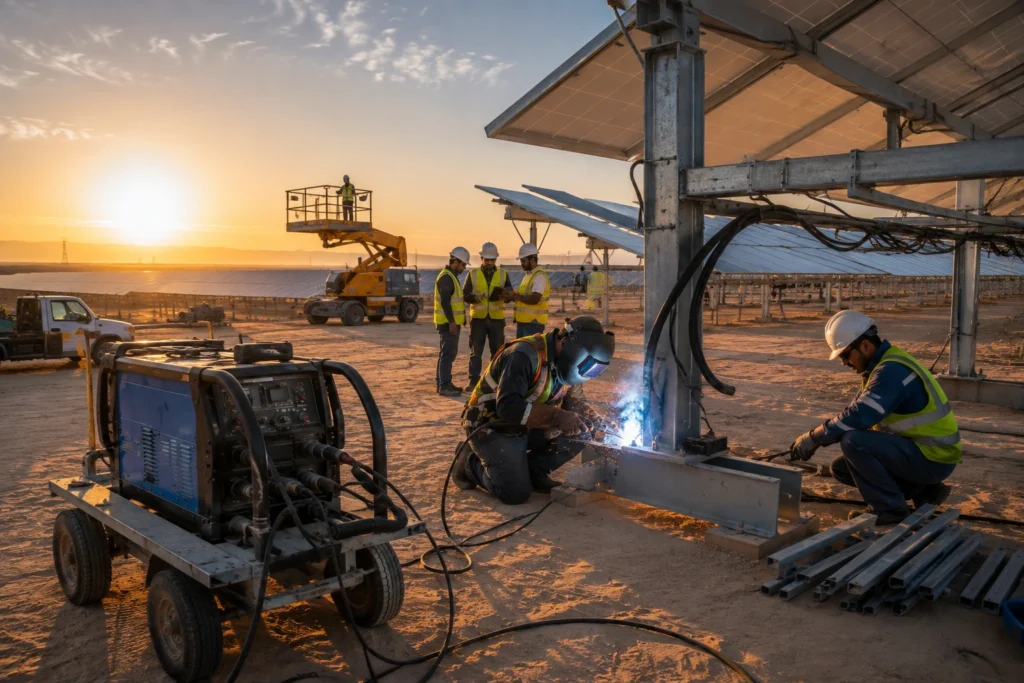
Rental Welding Machine Saudi Arabia solutions give contractors, fabrication companies, maintenance teams, and industrial operators a practical way to access professional welding equipment without committing to long-term ownership. When project requirements change, rental allows businesses to add welding capacity for a specific period, application, or worksite while keeping their permanent equipment fleet focused on everyday operations.
Across Saudi Arabia, welding is essential for fabrication, construction, industrial maintenance, infrastructure, energy, manufacturing, and heavy engineering. Each project can have different requirements for welding process, output, portability, power supply, and operating duration. A well-planned rental strategy helps companies match equipment to the job rather than making every project dependent on the same permanent machines.
Why Rent Welding Machines for Saudi Projects?
Buying welding equipment can make sense when a machine is used continuously. However, many industrial requirements are temporary.
A contractor may win a three-month fabrication contract. A plant may schedule a six-week shutdown. A maintenance company may need additional welding stations for an unexpected repair campaign. A fabrication workshop may suddenly have several projects running simultaneously.
In these situations, purchasing additional machines can create equipment that remains underutilized after the workload decreases.
Welding machine rental in Saudi Arabia provides another option. Businesses can increase their available welding capacity for the required period and return the equipment when the project is completed.
This can help with:
- Temporary production increases
- Short-term fabrication projects
- Industrial maintenance
- Planned shutdowns
- Emergency repairs
- Remote field operations
- Additional contractor teams
- Specialized welding applications
Fabricast Arabia specifically promotes flexible rental options and equipment suitable for short-term projects across Saudi Arabia.
Select the Welding Process Before the Machine
One of the most important decisions is identifying the welding process required for the application.
Different materials, thicknesses, joint designs, and production requirements can call for different technologies.
MIG Welding
MIG welding is widely used for fabrication and applications where productivity and continuous wire feeding are important.
It can be suitable for structural components, machinery fabrication, general steelwork, and production environments.
For projects that temporarily require additional MIG welding capacity, renting can provide extra workstations without permanently expanding the company’s equipment inventory.
TIG Welding
TIG welding provides greater control and precision and is commonly selected for applications involving stainless steel, aluminum, thinner materials, or work where weld appearance and control are particularly important.
Companies that only occasionally require specialist TIG capability may find rental more practical than purchasing dedicated machines that spend much of their time in storage.
ARC Welding
ARC or stick welding remains highly useful for field fabrication, repair, structural work, and maintenance.
Its suitability for many outdoor and industrial applications makes portable ARC equipment valuable when welding needs to move between different work areas.
Multi-Process Equipment
Some projects require more than one welding process.
Multi-process machines can provide greater flexibility where teams need to switch between processes while working from a compact equipment setup.
Fabricast’s current product range includes MIG, TIG, ARC, multi-process, and engine-driven welding equipment from several established brands.
Rental for Construction and Fabrication
Large Saudi projects can experience significant changes in welding requirements as different phases progress.
During structural fabrication, contractors may require multiple welding stations. Later, the requirement may reduce to maintenance and modification work.
Instead of purchasing equipment based on the project’s highest temporary demand, companies can supplement their permanent fleet with rental machines.
This approach allows project managers to scale welding capacity according to actual workload.
For fabrication workshops, rental can also help when several customer orders overlap. Additional machines can create temporary production stations and help existing welders work without waiting for machines to become available.
Supporting Industrial Maintenance
Maintenance operations often have strict completion deadlines.
During planned maintenance campaigns, several teams may work simultaneously on equipment, structures, pipe supports, platforms, and other steel components.
The normal plant welding fleet may not be sufficient for the additional manpower.
A rental strategy can provide the extra machines required during the maintenance period without turning temporary demand into permanent equipment ownership.
This makes industrial welding equipment rental particularly useful for shutdowns and turnaround projects.
Remote Work Requires Portable Equipment
Saudi Arabia’s industrial landscape includes projects that operate away from conventional workshops.
Remote infrastructure, pipeline work, energy projects, mining operations, and field maintenance can require welding equipment to be transported directly to the work area.
In these conditions, portability becomes an important selection factor.
Project teams should consider the machine itself as well as:
- Cable length
- Equipment weight
- Transportation method
- Power source
- Generator compatibility
- Site access
- Weather and environmental conditions
For locations without suitable electrical infrastructure, engine-driven welding generators can provide an independent welding power source. Fabricast lists Shindaiwa equipment for welding and power-generation applications, including engine-driven welding equipment.
The Benefits of Flexible Rental Periods
Project schedules do not always follow a fixed pattern.
Equipment might be needed for a few days, several weeks, or an extended industrial contract.
Flexible rental arrangements allow businesses to align equipment availability with the actual project schedule rather than purchasing equipment for an uncertain period.
Before confirming a rental, companies should clearly establish:
- Required start date
- Expected project duration
- Number of machines
- Welding processes
- Required output
- Delivery location
- Power requirements
- Accessories needed
Clear planning can make equipment deployment smoother and reduce the possibility of delays.
Maintaining Equipment Reliability
Rental equipment should be treated with the same care as owned equipment.
Before deployment, machines should be checked for general operating condition, cables, connectors, controls, cooling systems, and other relevant components.
Fabricast states that its rental equipment is maintained and that it provides maintenance and repair services in Saudi Arabia. The company also highlights fast and reliable delivery for welding equipment.
For industrial projects, equipment reliability matters because a welding machine failure can affect more than one worker. It can interrupt fabrication activities and potentially delay dependent operations.
Rental Can Reduce Equipment Bottlenecks
Imagine a workshop with ten welding stations and twelve welders scheduled for a major project.
Without additional equipment, two operators may have to wait for machines to become available.
Adding rental equipment can create additional stations for the temporary workload.
The same principle applies to larger projects with multiple crews.
Rather than waiting for permanent equipment to be transferred from another location, rental machines can be assigned to the project according to its immediate requirements.
Choosing a Supplier With a Broad Equipment Range
A supplier with multiple welding technologies can simplify procurement.
Instead of sourcing MIG machines from one company, ARC equipment from another, and engine-driven welders from a third provider, project teams can potentially consolidate several requirements through one supplier.
Fabricast’s website currently lists brands and equipment categories including Lincoln, JASIC, MEGMEET, ASTRA, Shindaiwa, and other welding-related products. Its range includes MIG, TIG, stick/ARC, multi-process, engine-driven welding equipment, and related industrial solutions.
This broader equipment selection can be useful when a single project requires multiple welding processes.
Plan Accessories Alongside the Machine
A welding machine is only one part of a working welding station.
Depending on the process, the project may also require appropriate cables, holders, torches, clamps, wire-feeding equipment, regulators, hoses, electrodes, filler materials, and PPE.
Before equipment is delivered, project managers should confirm what is included and what needs to be sourced separately.
This prevents a common operational problem: having the welding machine on site but not having all the components necessary to start work.
Safety Should Never Be a Rental Compromise
Temporary equipment should follow the same safety requirements as permanently owned equipment.
Operators should be properly trained and use appropriate PPE. Work areas should be assessed for electrical hazards, hot-work risks, fumes, sparks, combustible materials, and nearby personnel.
Project-specific procedures, permits, inspection requirements, and manufacturer instructions should also be followed.
The objective of rental is to provide temporary equipment flexibility—not temporary safety standards.
Fabricast Arabia for Welding Equipment Rental
Fabricast Arabia provides welding equipment rental and related industrial equipment solutions in Saudi Arabia.
Its website highlights rental options for short-term projects, a wide range of welding equipment, equipment maintenance and repair, technical support, and delivery services.
For businesses planning a rental requirement, the best starting point is to provide the supplier with the welding process, material, application, expected workload, project location, power availability, and rental duration.
This information helps identify equipment that is appropriate for the actual job rather than simply selecting a machine based on its maximum output.
Conclusion
Rental Welding Machine Saudi Arabia solutions can help businesses manage changing welding requirements without turning every temporary project into a permanent equipment investment.
From fabrication workshops and infrastructure projects to industrial maintenance, remote field operations, and shutdown campaigns, rental provides a flexible way to increase welding capacity when demand rises.
The right approach is to select equipment based on the application, welding process, power requirements, portability, operating environment, and project duration. When these factors are planned in advance, rental equipment can become an effective part of a broader project and asset-management strategy.
For Saudi industrial businesses, the goal is simple: have the right welding capability available when the work requires it, without carrying unnecessary equipment when the project is finished.