
Flexible Welding Solutions for Industrial Projects
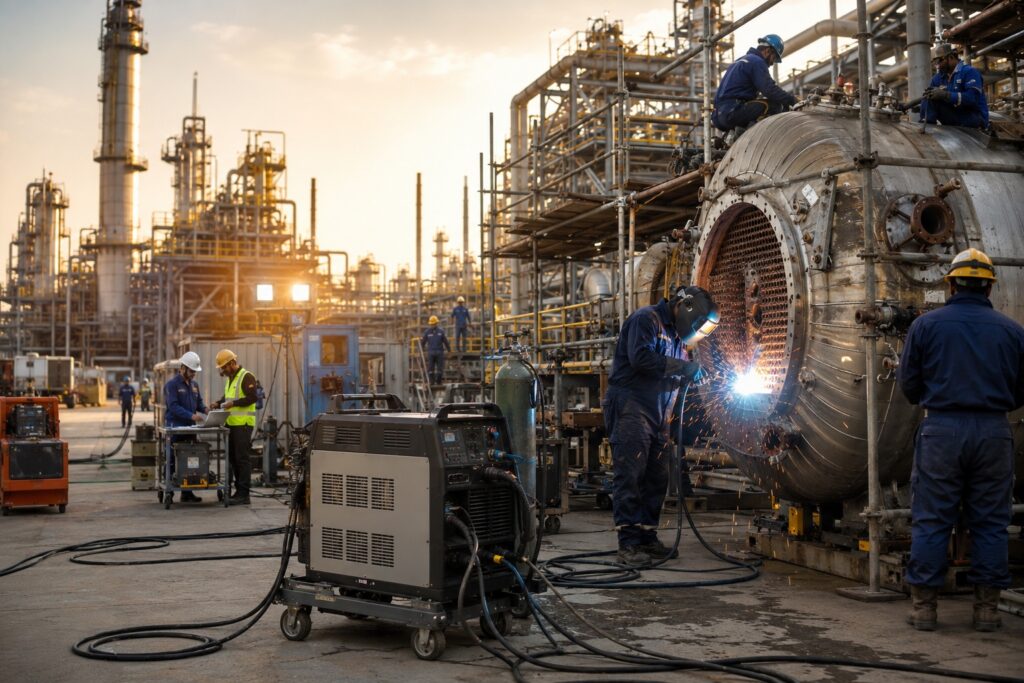
Choosing a rental welding machine Saudi Arabia solution gives contractors, manufacturers, and industrial teams flexible access to reliable welding equipment without the cost of permanent ownership. From fabrication and plant maintenance to infrastructure and temporary project requirements, rental welding machines help businesses increase capacity, maintain productivity, and respond efficiently to changing workloads.
Think in Terms of Welding Capacity, Not Machine Ownership
A welding machine has value when it is working. When equipment remains unused between contracts, it still occupies space, requires maintenance, and ties up capital.
For businesses with variable workloads, the more useful question is not “How many welding machines do we own?” but “How much welding capacity does this project require?”
Consider a steel fabrication contract that normally operates six welding stations but requires twelve stations during its busiest phase. Purchasing six additional machines for a temporary production peak may not be the most efficient use of capital.
Rental allows those additional stations to be introduced when production increases and returned when demand falls.
That makes welding machine rental KSA particularly relevant for businesses whose equipment requirements change from one contract to another.
A Welding Fleet Can Change During the Same Project
One of the most overlooked advantages of rental is the ability to change the equipment mix.
Industrial projects move through different phases. Early fabrication may require one process, assembly may require another, and final installation may involve field welding under completely different conditions.
Instead of expecting one machine type to cover everything, businesses can build a temporary fleet around each stage.
For example, a project could require:
MIG machines for repetitive steel fabrication
TIG machines for precision stainless-steel work
ARC machines for outdoor installation
Engine-driven welders for remote locations
Multi-process machines for maintenance teams
Access to industrial welding equipment rental makes it easier to align technology with the work being performed.
MIG Rental for Production Peaks
MIG welding is highly productive where repetitive fabrication and continuous wire feeding are required.
A fabrication company that receives a large structural steel order may need to add several welding stations quickly. Waiting for permanent equipment procurement can affect the production schedule.
Temporary MIG machines can expand capacity during the contract without permanently increasing the company’s equipment fleet.
This is particularly useful for steel workshops, manufacturing facilities, machinery fabrication, modular construction, and other production-oriented environments.
The objective is simple: add productive capacity when orders increase and reduce it when production returns to normal.
TIG Rental for Specialist Work
TIG equipment presents a different rental scenario.
A business may not perform precision stainless steel or aluminium welding every day, but a particular contract could suddenly require it.
Purchasing specialized equipment for occasional work can be difficult to justify.
Using TIG welding machine rental Saudi Arabia gives contractors access to suitable technology for a specific job while keeping equipment expenditure aligned with actual utilization.
This approach can be especially valuable for specialist fabrication, process equipment, stainless-steel components, and precision engineering work.
ARC Machines for Field Teams
Field welding creates its own equipment challenges.
Machines may need to move between structures, work areas, or even completely different project locations. Equipment must be practical, dependable, and suited to the available power conditions.
ARC welding remains useful for many such applications because of its versatility in structural work, repair, and maintenance.
A portable ARC welding machine can support crews working on steel erection, plant maintenance, equipment repair, pipe supports, and other field activities without requiring a permanent workshop setup.
For contractors managing several teams, renting additional machines can also prevent crews from waiting for shared equipment.
What Happens When a Project Suddenly Accelerates?
Project schedules can change quickly.
A customer may bring a deadline forward. Additional fabrication packages may be released. More welders may be assigned to a site. An unexpected repair may become urgent.
In these situations, equipment availability becomes a scheduling issue.
If ten qualified welders are available but only seven machines are operational, the missing equipment immediately limits productivity.
Temporary welding equipment for industrial projects can help close this gap. Instead of reorganizing crews around equipment shortages, project managers can increase machine availability to match manpower.
This is where rental becomes less about saving money and more about protecting project momentum.
Rental Can Support Planned Shutdowns
Industrial shutdowns operate under very different conditions from normal maintenance.
A large amount of inspection, repair, replacement, and fabrication work may need to be completed within a tightly controlled window. Additional technicians and contractors are often mobilized specifically for that period.
Those extra teams require equipment.
Maintaining enough welding machines permanently to cover an occasional shutdown may leave many units underutilized during normal operations. Rental provides a way to create a temporary equipment fleet specifically for the shutdown period.
Shutdown welding equipment rental can support repair teams while allowing the facility to return to its normal equipment level once planned work is completed.
Equipment Standardization Matters When Several Welders Are Working
Adding machines quickly should not create unnecessary complexity.
When possible, project managers should consider standardizing similar equipment across crews. Familiar controls and compatible accessories can simplify setup and reduce time spent adapting to different machines.
Before confirming a rental fleet, it is useful to review:
- Welding processes required
- Output range
- Duty cycle
- Power supply
- Torch and cable requirements
- Consumable compatibility
- Site conditions
A carefully planned fleet can make equipment deployment much smoother than simply ordering machines based on quantity.
Match Duty Cycle to the Real Working Day
Amperage receives considerable attention when welding equipment is selected, but duty cycle is equally important.
A machine suitable for intermittent repair work may not be appropriate for a production line where welders operate for extended periods.
Rental selection should therefore consider how the machine will actually be used during a normal shift.
Heavy fabrication, repetitive welding, and high-output applications may require heavy-duty welding machines designed for sustained industrial operation.
Choosing according to real workload helps prevent overheating, unnecessary interruptions, and lost production time.
Consider the Power Available at the Site
A welding machine cannot be selected independently of its power source.
Before deployment, project teams should confirm the electrical infrastructure available at the work location. Voltage, phase, generator capacity, cable length, and distribution arrangements can all influence equipment selection.
This becomes particularly important at temporary and remote sites.
Where grid power is limited or unavailable, engine-driven welding solutions may offer greater independence by combining field mobility with the power required for welding operations.
Planning power requirements before equipment reaches the site can prevent avoidable commissioning delays.
Mobilization Should Be Part of the Rental Plan
Industrial equipment does not become productive simply because it has been delivered.
A successful deployment considers where the machines will be used, how they will be moved, how cables will be routed, and what accessories each welding station requires.
For a multi-machine project, planning can include:
- Identifying welding locations.
- Assigning the appropriate machine type.
- Confirming electrical or generator supply.
- Preparing cables and accessories.
- Checking consumables.
- Inspecting machines before operation.
This site-level planning turns equipment availability into usable welding capacity.
Backup Machines Can Protect Critical Work
Some welding activities sit directly on the critical path of a project.
If a machine stops during a non-critical task, the impact may be manageable. If the same failure occurs during a time-sensitive pipeline repair, structural installation, or shutdown activity, the consequences can be much greater.
For high-priority work, keeping backup capacity available can be a sensible risk-management decision.
Temporary welding equipment rental gives project teams a way to add contingency machines without permanently increasing the company’s fleet.
The value of that backup is not measured only by its rental cost. It should also be compared with the potential cost of a stopped crew or delayed project milestone.
Rental Helps Businesses Test Different Equipment Strategies
Rental can also serve as a practical evaluation tool.
Before purchasing multiple machines for long-term use, a company may want to understand how a particular type performs under its actual working conditions.
Using equipment during a real project can reveal practical information about:
- Operator acceptance
- Welding performance
- Portability
- Productivity
- Setup requirements
- Suitability for specific materials
This can make future procurement decisions more informed.
Instead of evaluating equipment entirely from specifications, businesses can learn how different solutions fit their production environment.
Accessories Should Never Be an Afterthought
The welding power source is only one component of a complete welding station.
Depending on the process, the job may also require torches, electrode holders, earth clamps, cables, wire feeders, gas regulators, hoses, and appropriate consumables.
A machine arriving without the correct supporting equipment can still leave a welder unable to work.
Businesses therefore benefit from considering complete welding rental solutions rather than focusing exclusively on the power source.
Every station should be planned as a working system.
Where Rental Fits Within a Larger Equipment Strategy
Rental and ownership do not have to compete.
For many industrial businesses, the strongest equipment strategy uses both.
Frequently used machines can form the permanent core fleet. Rental equipment can then provide additional capacity for unusual, seasonal, specialized, or temporary requirements.
A fabrication company might own the machines used every day but rent additional units for large contracts. A maintenance contractor might own portable ARC equipment while renting TIG or high-output systems when specialized projects require them.
This hybrid approach can improve equipment utilization without limiting the company’s ability to accept new work.
Fabricast Arabia and Project-Based Welding Requirements
For businesses looking for welding and cutting equipment in Saudi Arabia, equipment selection should begin with the application rather than simply the machine category.
Fabricast Arabia supports industrial requirements where welding equipment, cutting technologies, consumables, and related solutions need to align with practical project conditions.
Whether equipment is required to expand a fabrication line, mobilize an additional field crew, support a shutdown, or provide temporary specialist capability, the objective should remain the same: put the correct welding technology where it can create productive working hours.
Conclusion
The real advantage of renting welding equipment is not simply avoiding a purchase. It is the ability to shape equipment capacity around the project.
A rental welding machine Saudi Arabia strategy can help businesses increase welding stations during production peaks, equip temporary crews, access specialist processes, support shutdowns, prepare backup capacity, and respond to new contracts without permanently expanding their equipment fleet.
For Saudi Arabia’s construction, manufacturing, fabrication, maintenance, energy, and heavy engineering sectors, that flexibility can make equipment planning more closely aligned with real operational demand.
The most effective rental decision therefore begins with three questions: what work needs to be completed, what welding process will complete it efficiently, and how long will that capacity actually be required?
When those questions are answered first, rental becomes a planned operational tool rather than an emergency solution.