
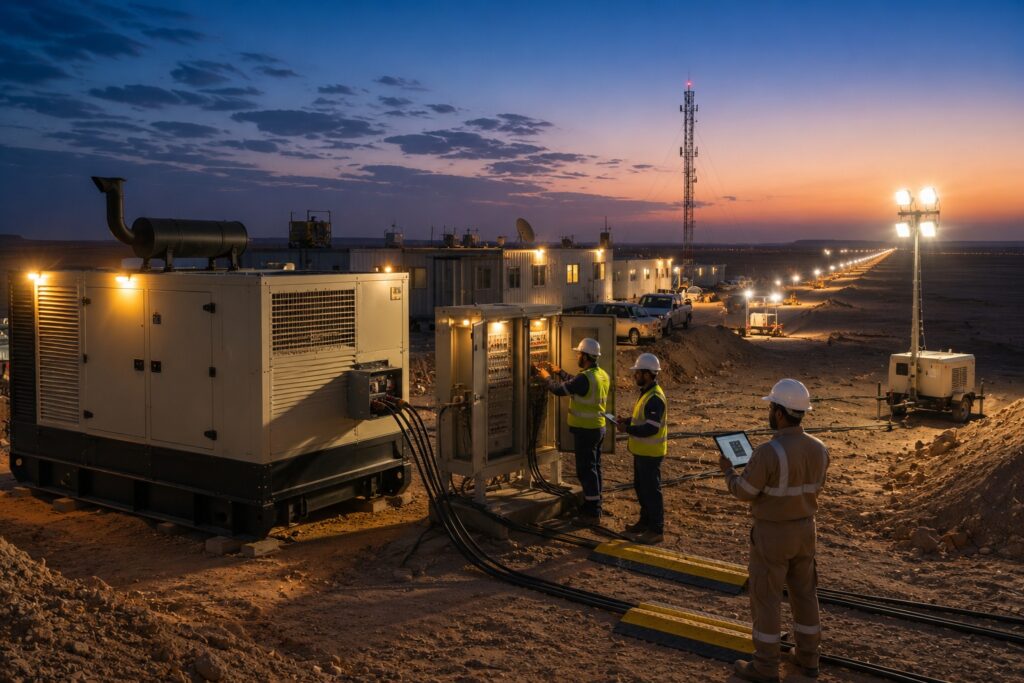
Diesel Generator Rental Saudi solutions provide reliable and flexible temporary power for construction sites, industrial facilities, remote projects, maintenance operations, and infrastructure developments across Saudi Arabia. By choosing the right generator capacity for actual site demands, businesses can maintain continuous operations, reduce downtime, manage changing power requirements, and avoid the significant investment associated with purchasing additional power equipment.
Start With the Load, Not the Generator
A common mistake in temporary power planning is choosing a generator first and calculating the electrical demand afterward.
The process should work in the opposite direction.
Before selecting equipment, identify everything that will draw power. Depending on the project, this could include welding equipment, pumps, compressors, lighting towers, site offices, ventilation systems, power tools, communication equipment, and temporary workshops.
Project teams should establish the expected operating load and identify equipment with high starting currents.
Selecting the correct industrial generator rental solution becomes much easier once the real electrical demand is understood.
Oversizing should not automatically be viewed as safer. An unnecessarily large generator can operate inefficiently, while an undersized unit may struggle when loads increase.
The objective is appropriate capacity with sufficient allowance for realistic operating conditions.
Why Starting Loads Matter
Electrical equipment does not always consume the same amount of power.
Motors, compressors, pumps, and similar equipment may require considerably more power during startup than during normal operation. If these temporary peaks are ignored, a generator that appears adequate on paper may experience voltage drops or overload conditions.
Power planning should therefore distinguish between continuous demand and temporary starting demand.
This becomes particularly important when several machines may start within a short period.
A well-planned temporary power solution Saudi Arabia accounts for the behaviour of connected equipment, not simply the sum of nameplate ratings.
Build a Power Map for the Project Site
Large projects often contain several work zones rather than one centralized electrical load.
A site could include a fabrication area at one end, temporary offices elsewhere, pumping equipment in another zone, and lighting distributed throughout the project.
Instead of positioning a generator wherever space is available, project teams can create a simple power map.
The map should identify where electricity is required, approximate load at each location, cable routes, distribution points, access roads, and areas where future expansion is expected.
This helps determine whether the project needs one central generator or several distributed units.
For geographically spread operations, portable diesel generators can sometimes provide more practical flexibility than transmitting temporary power over excessive cable distances.
Generator Placement Affects the Entire Setup
Where a generator is positioned influences safety, accessibility, cable management, refuelling, noise, and maintenance.
A suitable location should provide sufficient ventilation while allowing technicians to inspect the equipment easily. It should also support safe fuel access without interfering with normal site traffic.
Cable routing deserves equal attention.
Temporary cables should be protected from vehicles, heavy equipment, water, sharp edges, and areas where they could create trip hazards.
Generator deployment is therefore not just an equipment decision. It is part of overall site planning.
Power for Temporary Fabrication Zones
Major industrial developments frequently establish temporary fabrication areas close to the project.
These zones may contain welding machines, cutting equipment, grinders, ventilation systems, and other electrically powered tools.
The electrical demand can change significantly throughout the day as different machines are operated.
Using diesel generators for welding projects can provide independent power where permanent electrical infrastructure has not yet been established.
For welding applications in particular, stable power delivery is important because inconsistent electrical input can affect equipment performance and disrupt production.
Project managers should therefore consider the number and type of welding machines that may operate simultaneously.
Remote Projects Change the Power Equation
Some Saudi industrial operations take place far from established electrical networks.
Pipeline corridors, mineral developments, utility installations, road projects, telecommunications infrastructure, and remote maintenance locations may all require independent electricity.
In these environments, temporary power is not backup power. It may be the site’s primary source of electricity.
That changes equipment priorities.
Fuel planning, maintenance intervals, transportation access, operating hours, and equipment durability become central considerations.
A remote site generator rental strategy should be developed before crews arrive so that productive work can begin as soon as the site is mobilized.
Treat Fuel as Part of Power Planning
A generator cannot provide reliable electricity if fuel management is unreliable.
Projects operating for extended periods should estimate fuel requirements according to expected load and daily operating hours.
Planning should address where fuel will be stored, how frequently generators will be refuelled, and how refuelling will be coordinated with active site operations.
Fuel consumption can also provide useful operational information. Unexpected changes may indicate variations in load or potential equipment issues that deserve attention.
For heavy-duty generator rental, fuel logistics can become nearly as important as generator capacity.
What Happens When the Main Power Fails?
Temporary generators are not used exclusively on sites without electricity.
Industrial plants may also require standby power when existing electrical systems are being maintained, upgraded, or temporarily disconnected.
The consequences of an outage vary considerably.
Some operations can stop safely. Others may need electricity to maintain pumps, ventilation, control systems, communications, lighting, or other essential services.
This is where backup generator rental Saudi Arabia becomes part of contingency planning.
Instead of waiting for an interruption, businesses can identify critical loads in advance and determine what temporary power capacity would be required to maintain essential operations.
Planned Shutdowns Need Their Own Electrical Strategy
Industrial shutdowns create unusual electrical requirements.
Sections of a facility may be isolated while maintenance teams introduce temporary tools, welding machines, inspection equipment, ventilation, and lighting.
The facility may therefore require temporary electricity in places that normally rely on permanent systems.
A dedicated shutdown power rental solution allows temporary electrical infrastructure to be planned around maintenance activities rather than improvised once the shutdown begins.
This can help contractors mobilize crews more effectively and reduce delays caused by unavailable power.
Construction Projects Evolve—and Power Demand Evolves With Them
A construction project’s electrical requirements during initial site preparation can look completely different from those during structural work or mechanical installation.
Early activities may require basic lighting and tools.
Later phases can introduce:
- Welding stations
- Material-processing equipment
- Pumps
- Temporary workshops
- HVAC equipment
- Site offices
- Testing systems
The temporary power plan should therefore be reviewed as the project develops.
One advantage of construction generator rental KSA is the ability to adjust capacity as electrical requirements change rather than committing to a fixed configuration from the beginning.
Distribution Equipment Is Just as Important
The generator produces electricity, but that electricity still needs to reach the equipment safely.
Depending on the project, the temporary electrical system may require distribution boards, appropriate cabling, connectors, protective devices, and other supporting components.
A generator with sufficient capacity can still fail to meet project needs if distribution has been poorly planned.
Before mobilization, teams should understand how power will move from the generator to each load and whether cable distances could affect the setup.
Thinking of the generator as one part of a complete industrial temporary power system creates a more practical deployment strategy.
Should a Project Use One Large Generator or Several Smaller Units?
There is no universal answer.
A centralized generator can simplify some aspects of operation and maintenance, particularly where loads are concentrated.
Multiple smaller generators may provide greater flexibility when work zones are widely separated or operate independently.
Distributed units can also make it easier to relocate power as the project progresses.
The decision should consider site layout, load concentration, cable distances, mobility, redundancy, and expected changes during the project.
Rental makes this planning more adaptable because the generator configuration can be adjusted without permanently owning every unit.
Plan for Critical-Load Redundancy
Not every load has the same importance.
If temporary office lighting stops briefly, the disruption may be manageable. If electricity supporting a critical industrial process stops, the consequences may be much more significant.
Project teams should classify electrical loads according to operational importance.
Critical loads may justify backup capacity or an alternative power arrangement.
A well-designed emergency generator rental plan should focus first on maintaining essential operations rather than attempting to power every non-critical load during an interruption.
Environmental Conditions Should Influence Selection
Saudi Arabia’s operating environment must be considered when planning temporary power.
High ambient temperatures can affect equipment performance. Dust can accumulate around components. Outdoor generators may operate for long periods under demanding site conditions.
Projects should therefore consider equipment condition, ventilation, maintenance, and manufacturer operating requirements.
Regular inspections are particularly important for generators used continuously.
The aim is not merely to deliver electricity on the first day. Reliable temporary power must continue throughout the required rental period.
Monitor the Generator as the Project Changes
The load calculated during project planning may not remain accurate.
Additional equipment may be connected. Work schedules may change. Temporary facilities may expand.
Monitoring operating conditions helps teams understand whether the generator remains appropriately matched to actual demand.
Project personnel should also avoid connecting new high-load equipment without considering its effect on the existing temporary power system.
Treating generator capacity as a managed resource helps prevent gradual overloading as projects expand.
Rental and Ownership Can Work Together
Businesses do not need to choose exclusively between owning and renting generators.
Organizations with predictable everyday power requirements may own core equipment while renting additional units for unusual projects, seasonal demand, shutdowns, or remote operations.
This hybrid strategy can reduce the number of underutilized generators kept permanently in the fleet.
Access to generator rental services Saudi Arabia then becomes a way to extend internal capacity whenever project conditions require it.
Temporary Power Should Be Planned Early
Generator rental works best when power requirements are considered before site mobilization.
Early planning gives project teams time to assess loads, determine distribution requirements, select appropriate generator capacity, plan fuel logistics, and prepare safe installation locations.
Late planning often results in compromises.
For contractors and industrial businesses working across Saudi Arabia, temporary power should therefore be treated with the same importance as equipment mobilization, manpower planning, and material supply.
Fabricast Arabia and Industrial Project Requirements
Industrial projects frequently require several equipment categories to work together. Welding machines, cutting equipment, generators, accessories, and consumables can all form part of the same operational requirement.
Fabricast Arabia supports welding, cutting, and industrial equipment requirements for projects in Saudi Arabia.
When evaluating temporary power, the objective should be to select equipment around actual operating conditions—load, location, duration, mobility, and the equipment being powered.
Conclusion
Reliable temporary electricity begins long before a generator is switched on.
The strongest Diesel Generator Rental Saudi strategy starts by identifying loads, understanding startup requirements, mapping work zones, planning distribution, preparing fuel logistics, considering environmental conditions, and deciding which operations require redundancy.
This planning-led approach allows businesses to use rental equipment more effectively across remote worksites, industrial shutdowns, fabrication areas, infrastructure developments, and temporary facilities.
Instead of asking only, “What size generator should we rent?”, project teams should ask a broader question: “How should temporary power support every stage of this project?”
That question leads to a more reliable and scalable power strategy.